V.L

KeepCup
App Design
Project Brief
KeepCup is a Melbourne based company that delivers sustainable coffee cups. The mission is to encourage the use of reusable cups. They want to create a global brand and become one of the brands that kick-started the demise of the disposable cup.
My Contribution
I have been involved in this project from start to finish, which includes performing user research, defining personas and user journeys, creating wireframes and prototypes, conducting usability test.
My Role
UX Designer
Tools
Sketch, Invision, Adobe Photoshop
Duration
2 weeks
Team Size
2 people
DISCOVERY & RESEARCH
Challenge: How might we encourage more people to use reusable cups?
KeepCup is not about having – it’s about reusing. Creating a sense of value around KeepCup ownership helps drive the decision to make reuse a part of daily life. KeepCup company is mindful that a KeepCup unused in the cupboard is part of the problem, not the solution.

Background: Disposable Cup Pollution
-
Disposable coffee cups, which appear to be made of paper, have been found to contain thin layers of plastic that do not break down and damage the environment.
-
It has become the second-largest contributor to litter waste after plastic bottles.
-
Australians use an estimated 1 billion takeaway coffee cups each year.
-
One of the leading solutions is: to bring your own reusable cup.
How do coffee drinkers use KeepCup in cafes?
To begin, we visited 3 Cafes for contextual inquiry, we observed people’s behaviour and interviewed the staff in the cafe. And we found:

Around 40% people bring their own cup when coming to the cafe

One of the cafes provide 50 cents discount if the customers bring their own cup
We wanted to know why they use or don’t use a reusable cup, and how they feel about using it. To validate this we conducted interviews. We interviewed 10 people and found out:

4/10 own and use the reusable cup every day for the following reasons: conserve the environment, good design, reflection of personality, discount from cafes.

4/10 own a reusable cup but do not use it frequently because easy to forget, frequent washing-up, difficult portability.

2/10 do not use a reusable cup as they think it is inconvenient and unnecessary, and not sure if it really helps the environment.
SYNTHESISE & DEFINE
With the information we gathered in our research, we developed personas and journey maps to understand our users in more depth.
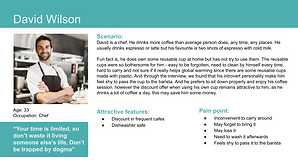
We developed three personas based on our research. Pain Chloe who owns a KeepCup but do not use it very often as the KeepCup company is mindful that a KeepCup unused in the cupboard is part of the problem, not the solution. The business goal was always to kick start behaviour change, from discard to reuse and continue to use them because they form a positive habit.


We then developed a user journey map of our primary users to learn more about their thoughts and feelings while obtaining a KeepCup, using a KeepCup and after using a KeepCup. By doing this, we were able to find out the potential design opportunities
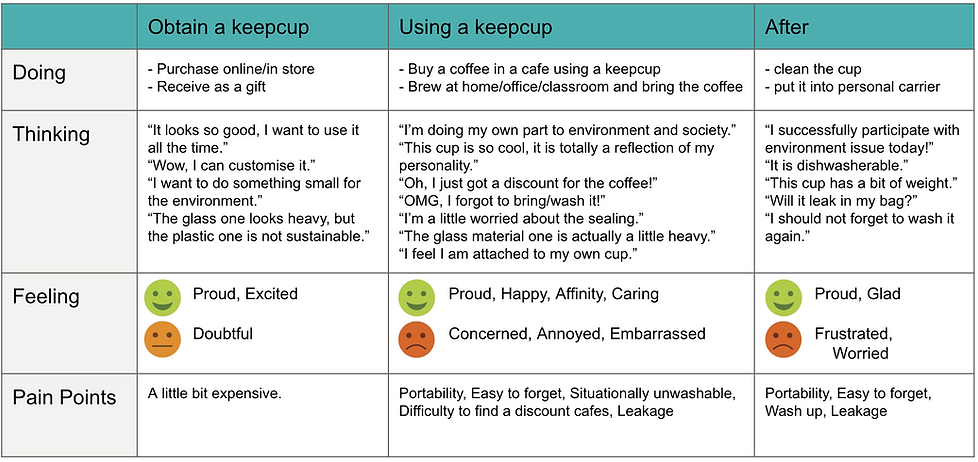
Key Findings:
The main reason people use a reusable cup:
-
Users feel proud when doing their own part for the environment
-
The cup looks good and it reflects their personality
-
Users receive discounts in cafes when using their own cup
The main reason people do not use reusable cups:
-
Inconvenient to carry around
-
Forget to bring it/wash it
-
Difficult to find a cafe that provides discount
Solution:
Through all this research, we believe we can motivate people to use a KeepCup by,
-
Creating a way to support further meaningful contribution to the environment and society
-
Encourage non-users to join by promoting technical convenience and overall cost savings.
DEVELOP & DELIVER
With the potential design opportunities, we stepped into the design phase.
We developed an MVP through MSCW to prioritise the features we should create in our application within the time we have.

There are three features we would like to develop in our Application:

Grow a tree with the stamps you collect every time you use your own cup

Locate the cafes that provide discount if you bring your own cup (cafe nearby or in a particular area)
Reminder to bring
the cup with you and wash the cup when you get home
As a team, we then sketched rapid wireframes for the three key features and conducted a few usability tests using paper prototypes to get some early feedback on the key flow.


Throughout the test, a few issues began to arise, We then tested the following iteration on users to gain further insights and feedback on the application. These were the main changes we made:
-
User has difficulty finding the QR code scan button as they are not familiar with the QR scanner icon. A note ”scan” was added below the button.
-
Users was confused with the tree icon in the bottom menu bar, the button was updated to a more recognisable one.


-
Users expect the map to automatically locate the nearest discount cafes without searching anything, the auto-search function was added.


-
Users expect to see the stamp collecting record of each cafe, it was added to the cafe page.


NEXT STEP
-
Conduct further usability tests on our final prototype
-
Implement additional features: Donation options, Customisation Options etc.